17 Travertine Bathroom Ideas for a Warm, Timeless Retreat

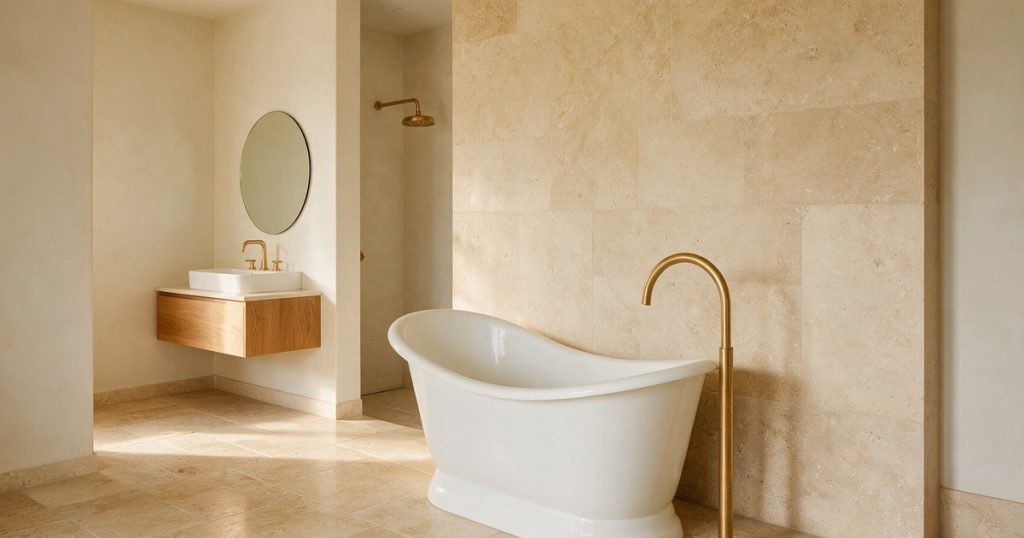
I used to think travertine belonged on a Tuscan terrace, not in a bathroom. Then I kept noticing how a room clad in it goes quiet in the best way, all warm stone and soft shadow, and I came around completely.
Travertine is the warm, timeless antidote to the cold white bathroom we all got tired of. It is a limestone cousin, full of natural pits and movement.
The cut, the finish, and the way it is laid change everything about how it reads. Below, I have pulled together seventeen distinct ways to use it, from rough tumbled tile to glossy slabs, with the palette and the practical kit to recreate each one.
1. Tumbled Travertine Bathroom
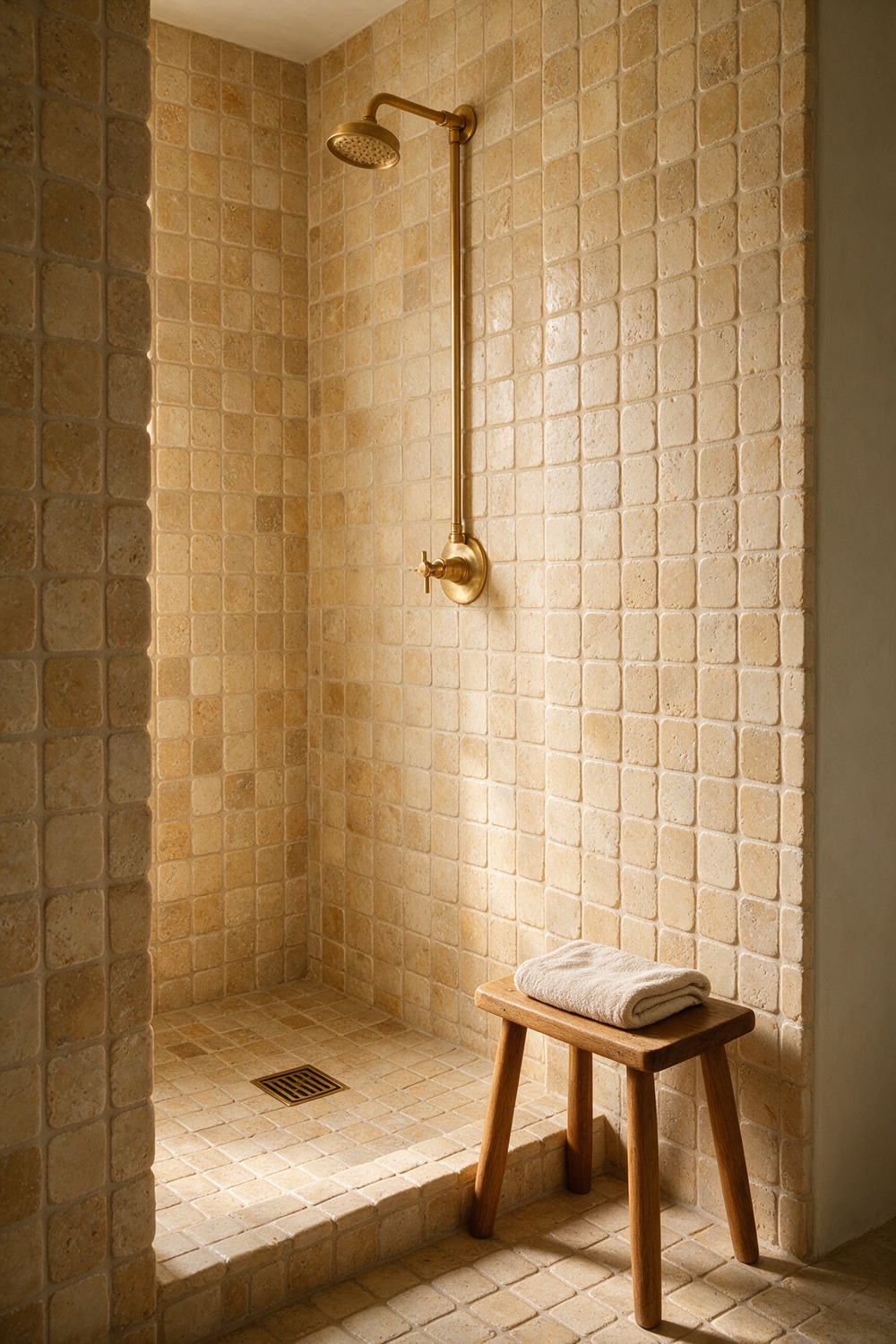
Tumbled is travertine that has been rolled in a drum until its edges go soft and rounded, like a stone you would pocket off a beach. It is the most forgiving version, and my favorite for a room that should feel old and lived-in rather than showroom-new.
There is a reason it reads so calm. The matte, chalky surface swallows glare instead of throwing it back, so even a bright morning in here feels hushed. Underfoot it has a faint grip, nothing slick about it.
Lean into the honey and oatmeal tones. For the walls above the tile, a chalky off-white like Bauwerk limewash in a warm cream keeps the whole thing matte and quiet.
Ask your tile shop for 4×4 tumbled travertine in a classic ivory, and let the grout go slightly sandy rather than stark white. The shower wall is where I would spend the texture first, since that is where it earns its keep.
2. Vein-Cut Travertine Bathroom
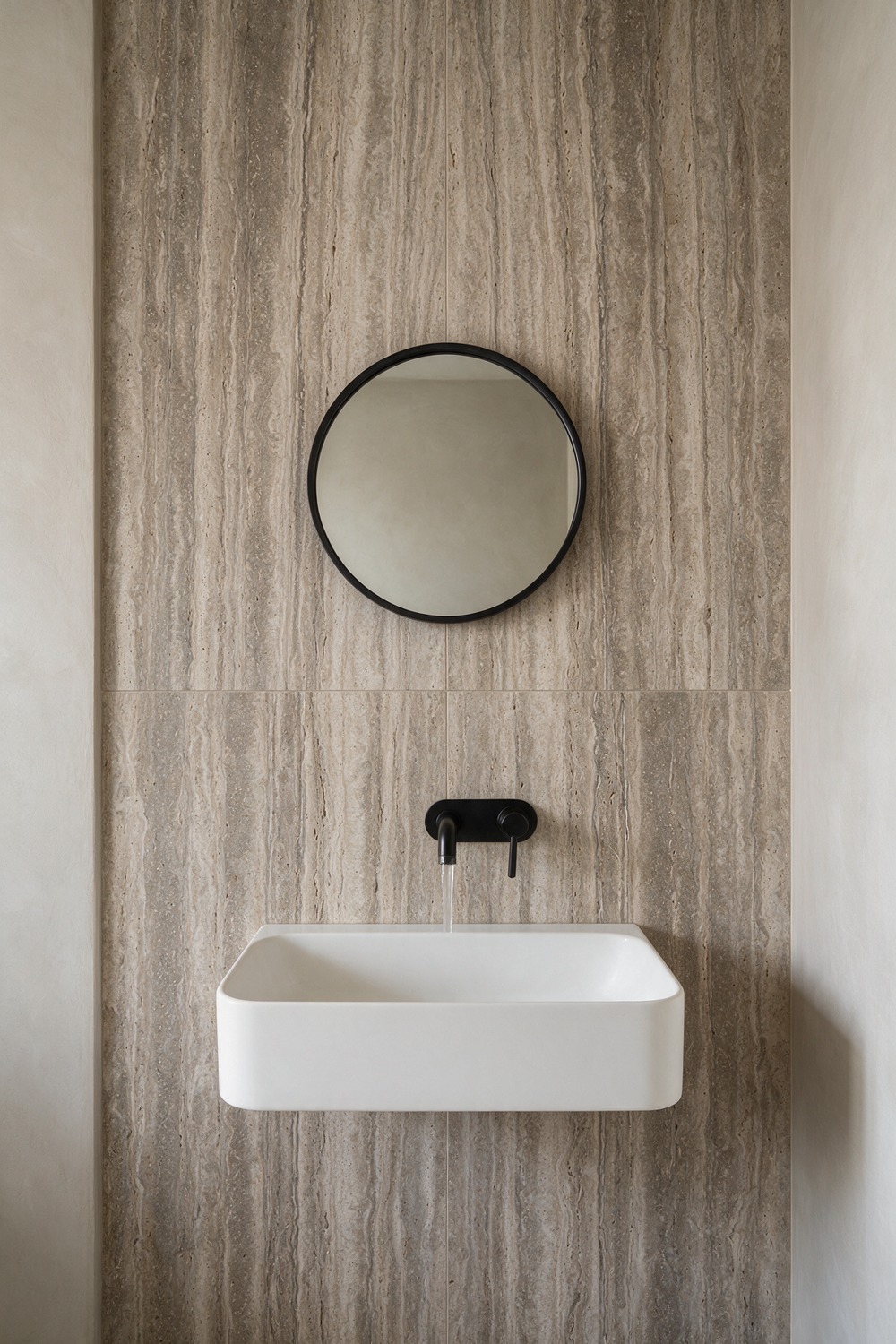
Here is the one distinction worth learning before you buy anything. Vein-cut travertine is sliced along the stone’s bedding plane, so it shows long, linear striations that run in one direction like grain in wood. It is architectural and calm, and it makes a small wall look taller.
Run those veins vertically behind the vanity and the eye travels up. The palette is greige and taupe, so pair it with a soft putty wall, think Little Greene’s Rolling Fog, and a matte-black tap for contrast.
Spec large honed vein-cut slabs or 12×24 planks, and keep grout lines tight and tone-matched. Treat the stone as the hero so everything else stays plain.
3. Cross-Cut Travertine Bathroom
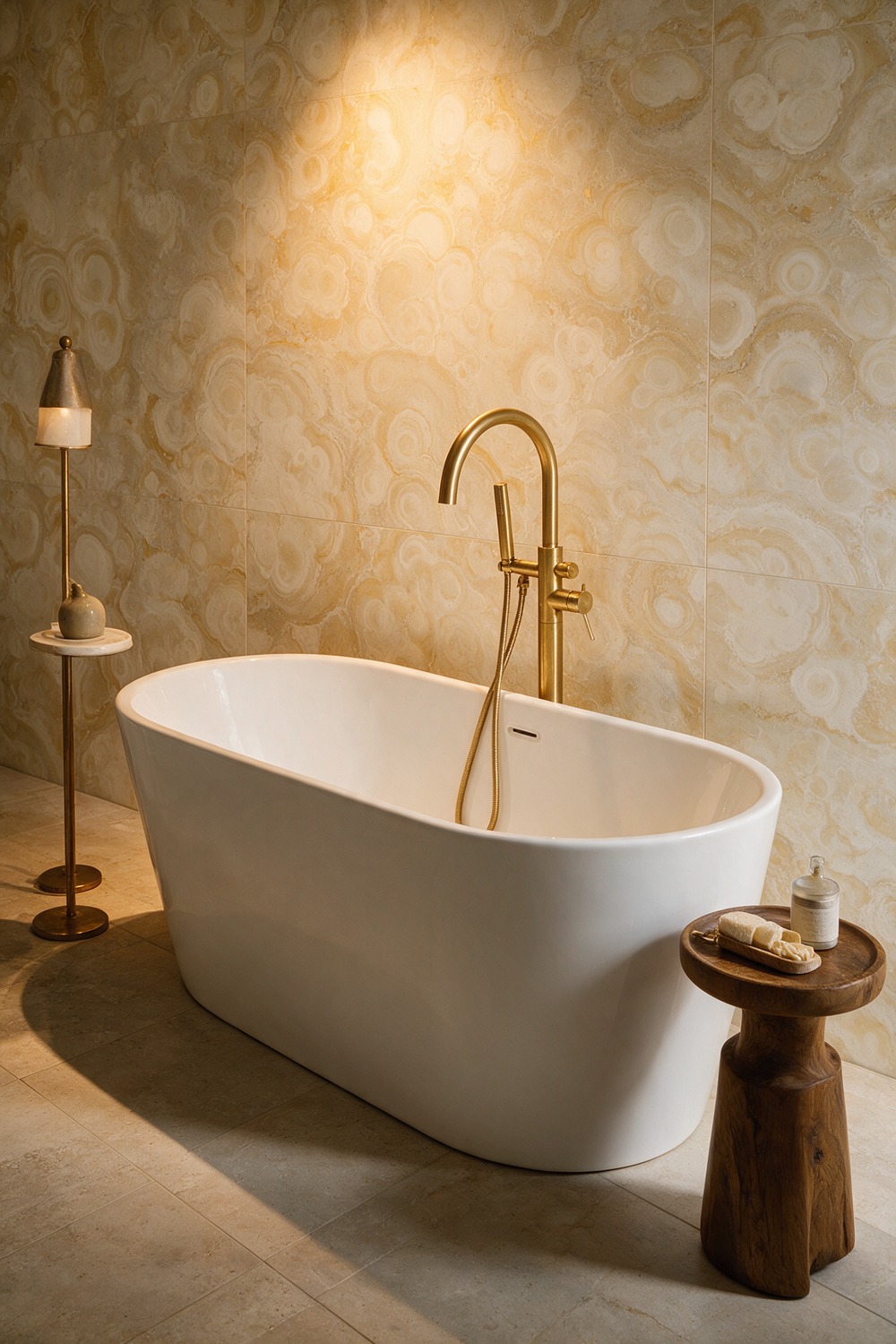
Cross-cut is the same stone sawn the other way, against the bedding, so instead of straight veins you get soft, cloudy, almost floral swirls. It reads busier and more organic. If vein-cut is a pinstripe, cross-cut is watercolor.
This one wants to be seen, so give it a full feature wall or a wrapped shower. The tones run cream to pale gold, which loves a warm 2700K bulb overhead.
Match the wall paint to the lightest cloud in the stone, something like Benjamin Moore White Sand, and ask for honed cross-cut large-format tile so those swirls stay uninterrupted. The wettest wall is the place to commit first, then build out from there.
4. Honed Travertine Bathroom
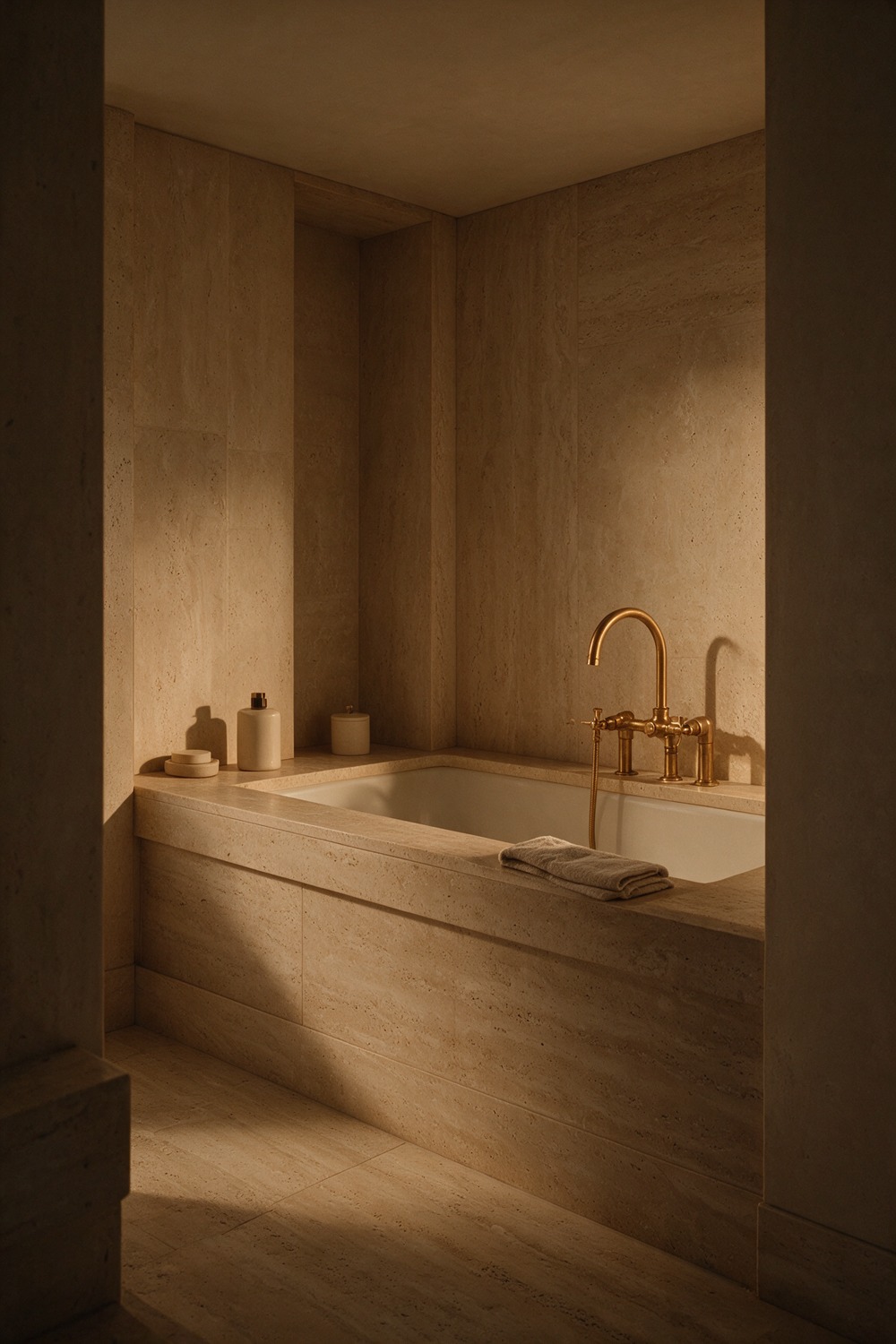
Honed is a finish, not a cut. The stone is ground flat to a smooth, matte, satin surface with zero shine. This is the finish I recommend to almost everyone, because it looks expensive without the glare and it hides water spots far better than gloss.
A honed room feels like a spa at dusk. Keep the palette tonal: sand walls, a honed travertine floor, and unlacquered brass fittings that will patina over time.
If you only learn one word from this list, make it honed. It is the finish that lets you live with natural stone without babysitting every splash, and it photographs like money while costing far less than slab marble.
For paint, a greige like Dulux Egyptian Cotton sits right against the stone. Ask for honed finish specifically when you order, pair it with a warm-metal tap, and start the whole scheme from the floor up.
5. Polished Travertine Bathroom
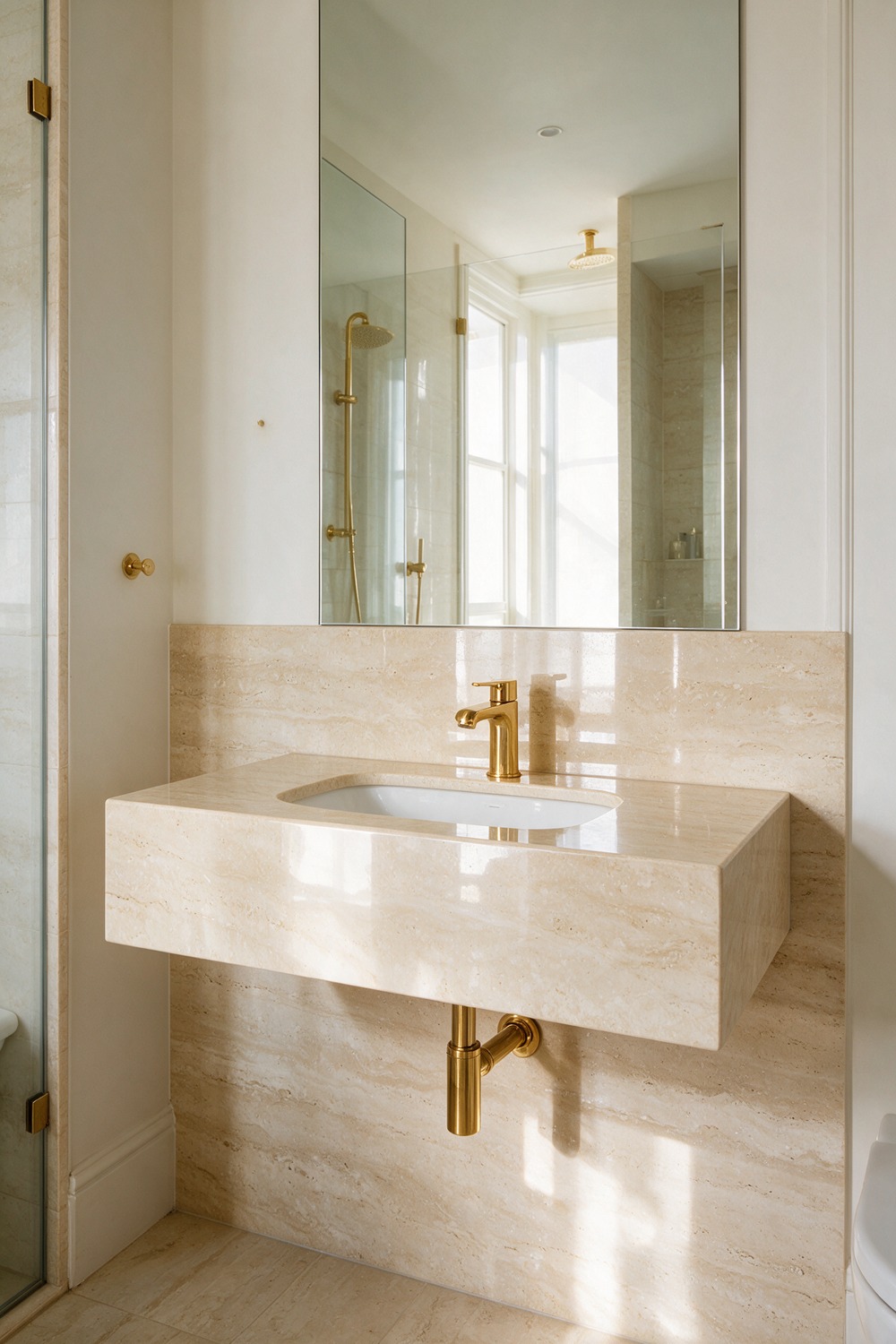
Polished travertine is buffed until it gleams, catching light like soft marble. It is the glamorous end of the family, built for a room that wants a little drama. I would keep it off a wet shower floor, but on a wall or vanity top it is gorgeous.
Think of a Nancy Meyers bathroom, all glow and calm money. The polished surface bounces light, so the warm cream stone and soft white walls, think Benjamin Moore White Dove, stay luminous.
Order polished slabs for the vanity and one feature wall, add a gold-toned tap, and let a big mirror double it.
6. Brushed Travertine Bathroom
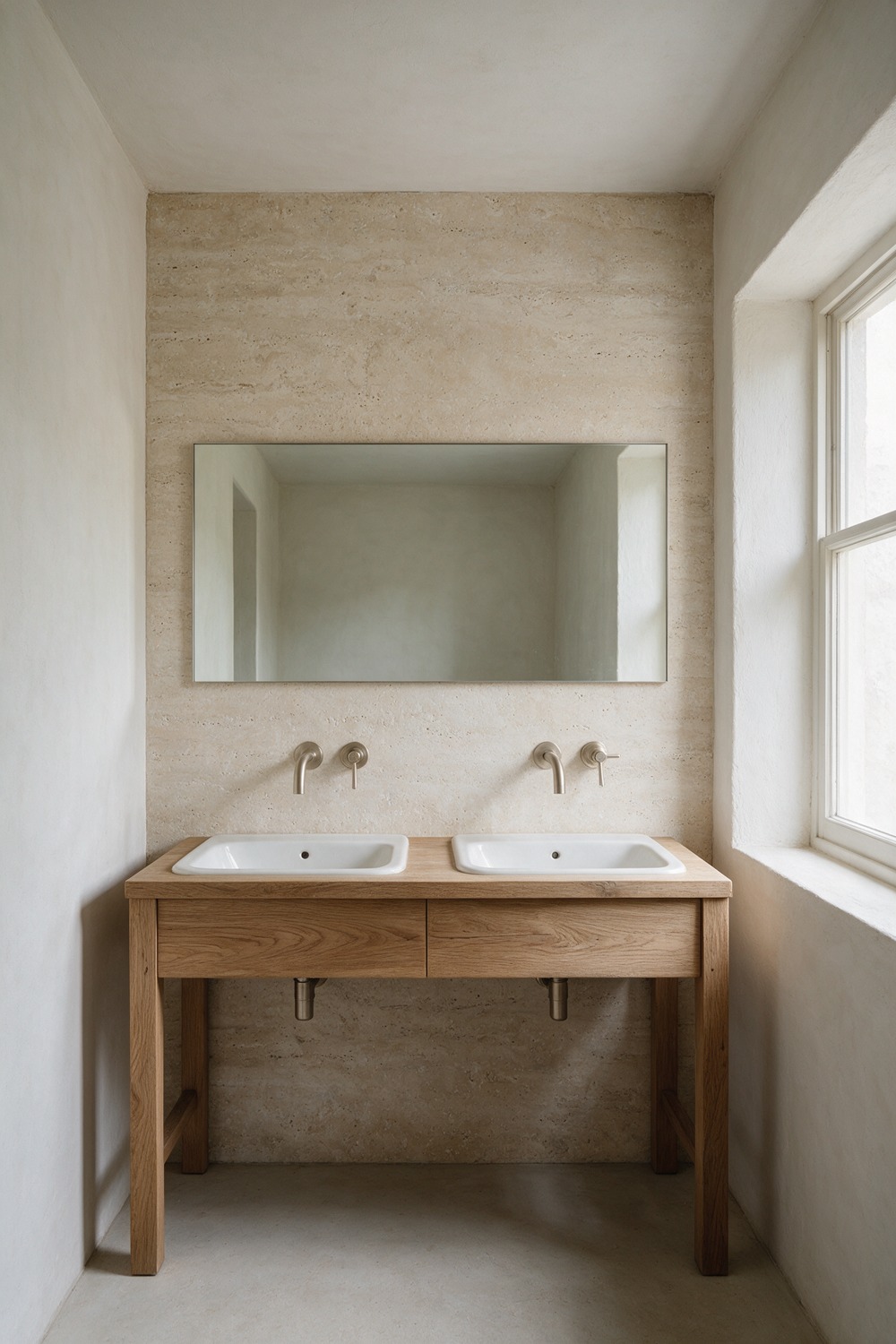
Brushed travertine gets a wire brush dragged across its face, which opens up a soft, textured, slightly weathered surface, matte but tactile. It splits the difference between tumbled’s rusticity and honed’s smoothness. Run your hand over it and you feel the stone.
The look is understated and earthy: pale biscuit tones, a limewashed wall in a warm white like Backdrop’s Mother of Pearl, and raw oak joinery.
Spec brushed-finish travertine in a 12×12 or large plank, and keep the metals warm and brushed too. Put it on the vanity wall first, so the texture meets you at eye level.
7. Chiseled-Edge Travertine Bathroom
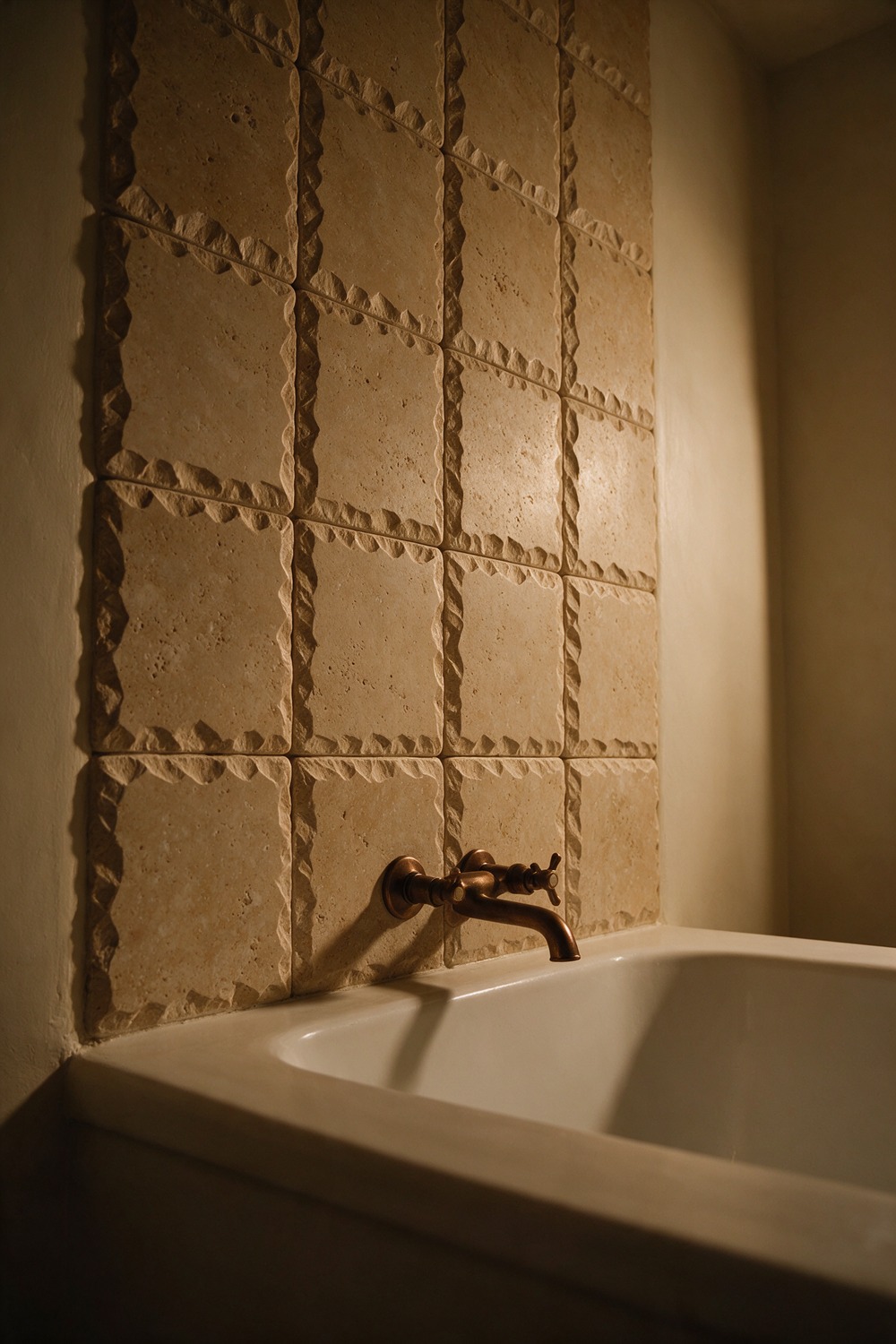
Chiseled-edge tiles have hand-chipped, beveled borders that cast tiny shadows and give each piece a dimensional, Old-World frame. The effect is rustic and handmade, the opposite of a flat modern grid. It is a lot of character, so use it with restraint.
One chiseled-edge wall is plenty. The beige stone with its shadowed edges wants warm, low light and a creamy wall, say Sherwin-Williams Natural Choice, to keep the mood soft.
Ask for a chiseled or bullnosed rustic edge on 4×4 or 6×6 tile, and grout in a matching sand tone so the bevels read. Begin behind the tub, where the texture feels like a grotto.
8. Filled Travertine Bathroom
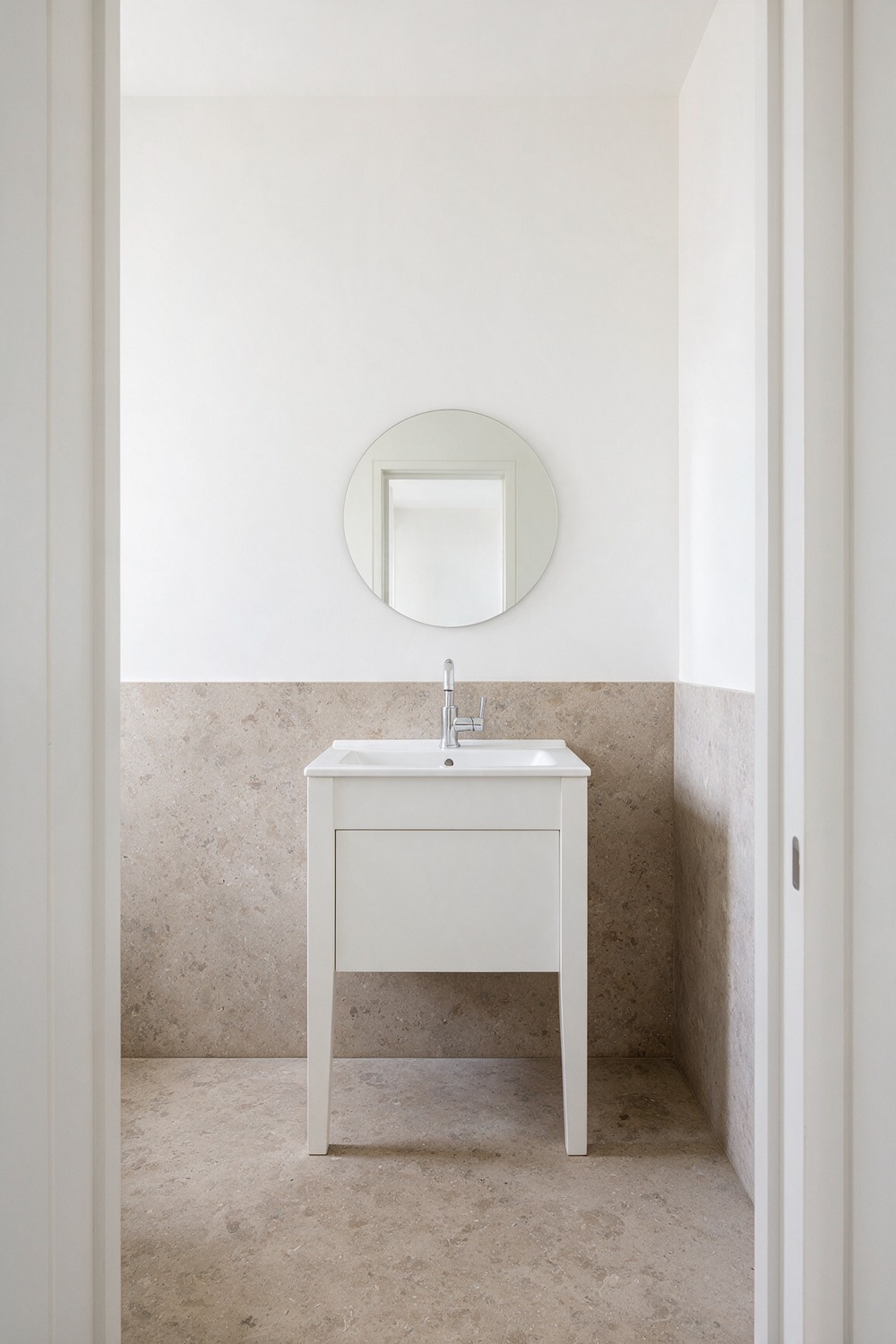
Travertine is naturally full of little holes, and filled means those pits have been filled with resin and then finished smooth. The result is a clean, continuous, low-maintenance surface.
If you want travertine’s warmth without the fuss of debris collecting in open pores, this is your answer. Filled and honed together give you the most seamless floor possible.
Keep it serene: a greige floor, white walls in Behr Swiss Coffee, and simple chrome or nickel fittings. Order filled and honed travertine explicitly, run it floor and lower wall for a continuous wrap, and start from the floor so the plane feels unbroken.
9. Unfilled Travertine Bathroom
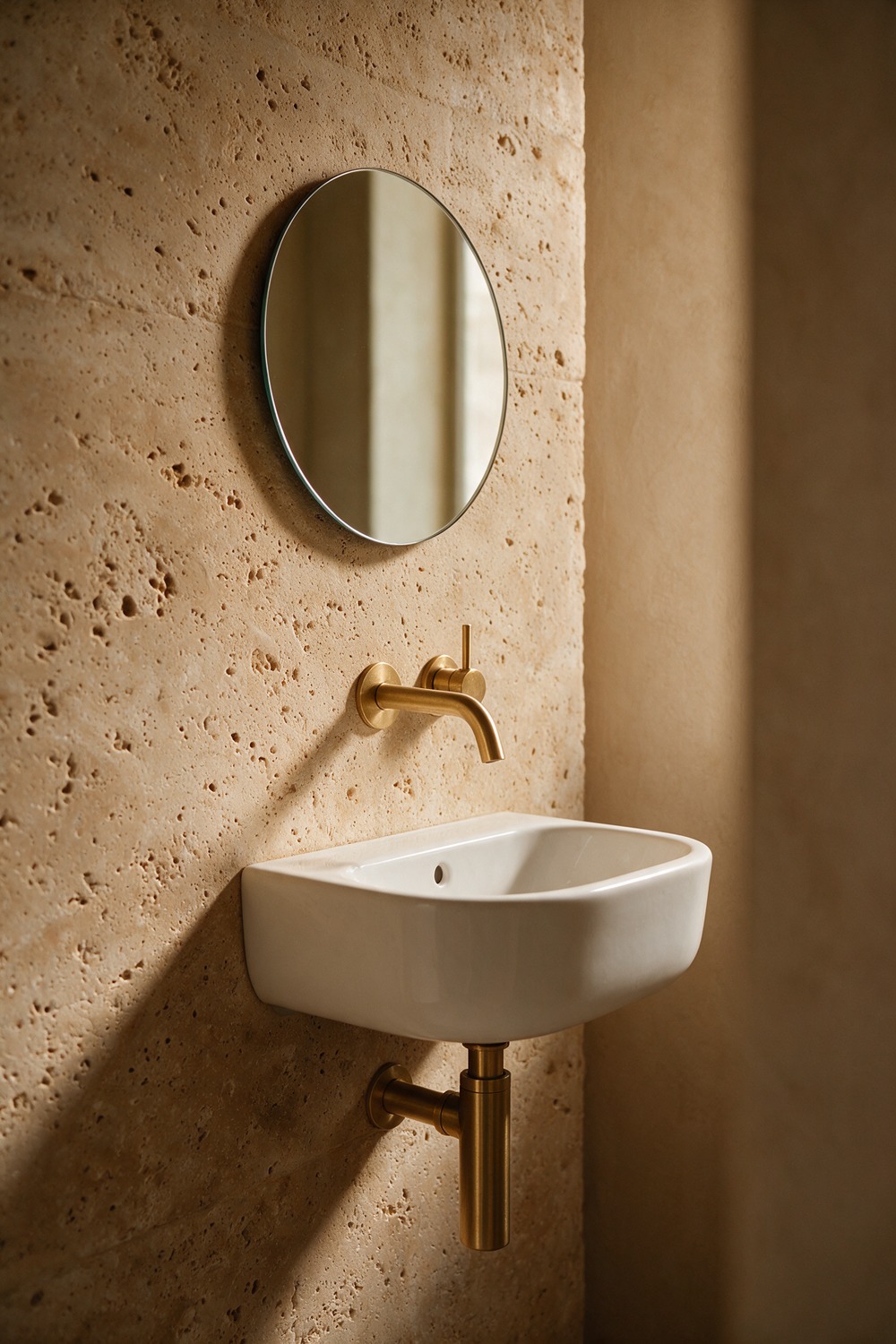
Unfilled is the honest version, pits and all. Those open pores read as texture and age, and I love this for a sink splashback or a feature niche, somewhere the eye can appreciate the rawness up close.
Pair the pitted stone with smooth plaster so the textures play off each other. A warm clay wall, maybe Little Greene’s Clay Mid, sets it off. Ask for unfilled, honed travertine, seal it well since the pores hold water, and keep it to one wall or niche.
10. French Pattern Travertine Bathroom
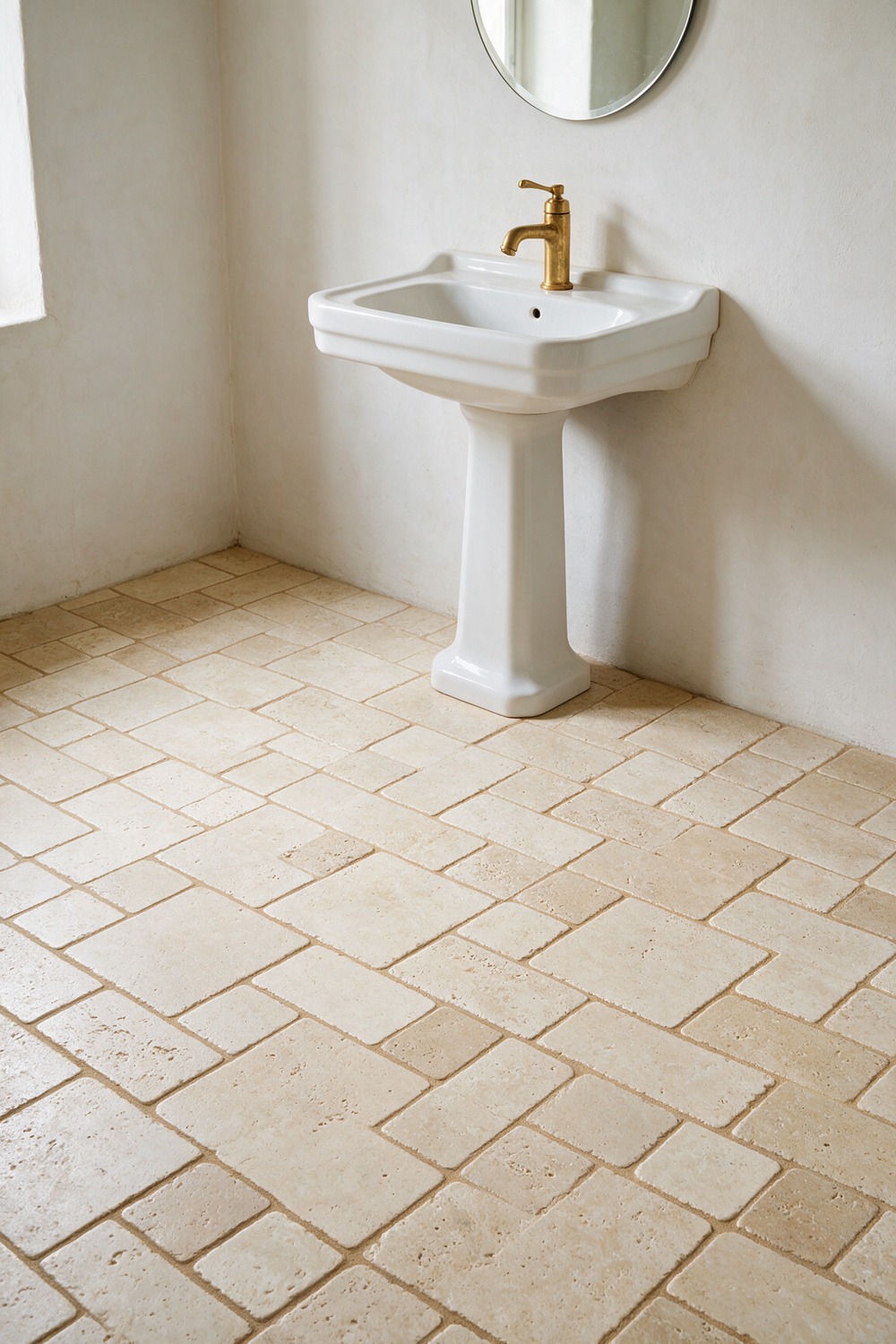
The French pattern, sometimes called the Versailles pattern, uses four different tile sizes laid in a repeating module so the joints never line up in a boring grid. It is the classic travertine floor you have seen in old villas, and it brings instant heritage.
This pattern wants a floor to show it off. Keep the walls quiet, a soft limewash in a warm white, so the geometry on the ground does the talking.
Here is the part people miss: the magic is in the irregularity. Because the four sizes interlock without a repeating seam, your eye never locks onto a grid. The floor reads as hand-laid heritage, the most convincing way to fake a few centuries.
Buy a French-pattern or Versailles travertine kit, since the four sizes come bundled, and lay it tumbled and filled for that aged look. Start the layout from the room’s center line so the pattern reads balanced.
11. Herringbone Travertine Bathroom
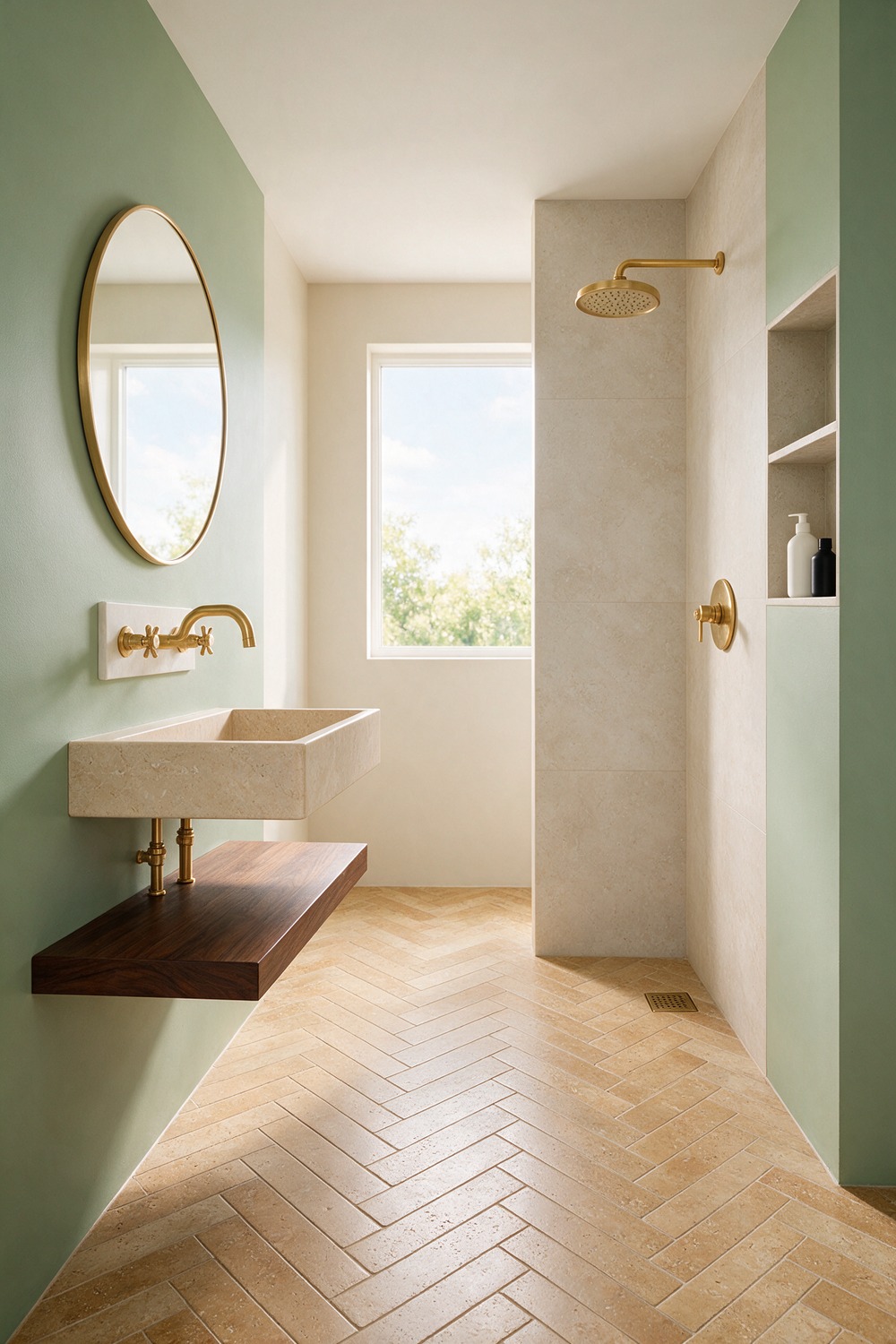
Take rectangular travertine planks and lay them in a tight V and you get herringbone, that zigzag that makes a floor feel tailored. It is a little more modern than the French pattern, and the diagonal energy makes a narrow room feel wider.
Herringbone on the shower floor is a quiet luxury I never tire of. The warm stone pairs beautifully with a sage or putty wall, something like Farrow & Ball Card Room Green for a soft earthiness.
Spec 2×8 or 3×12 honed travertine planks and set them in a true herringbone. Start at the focal wall so the point of each V leads the eye in.
12. Hexagon Travertine Bathroom
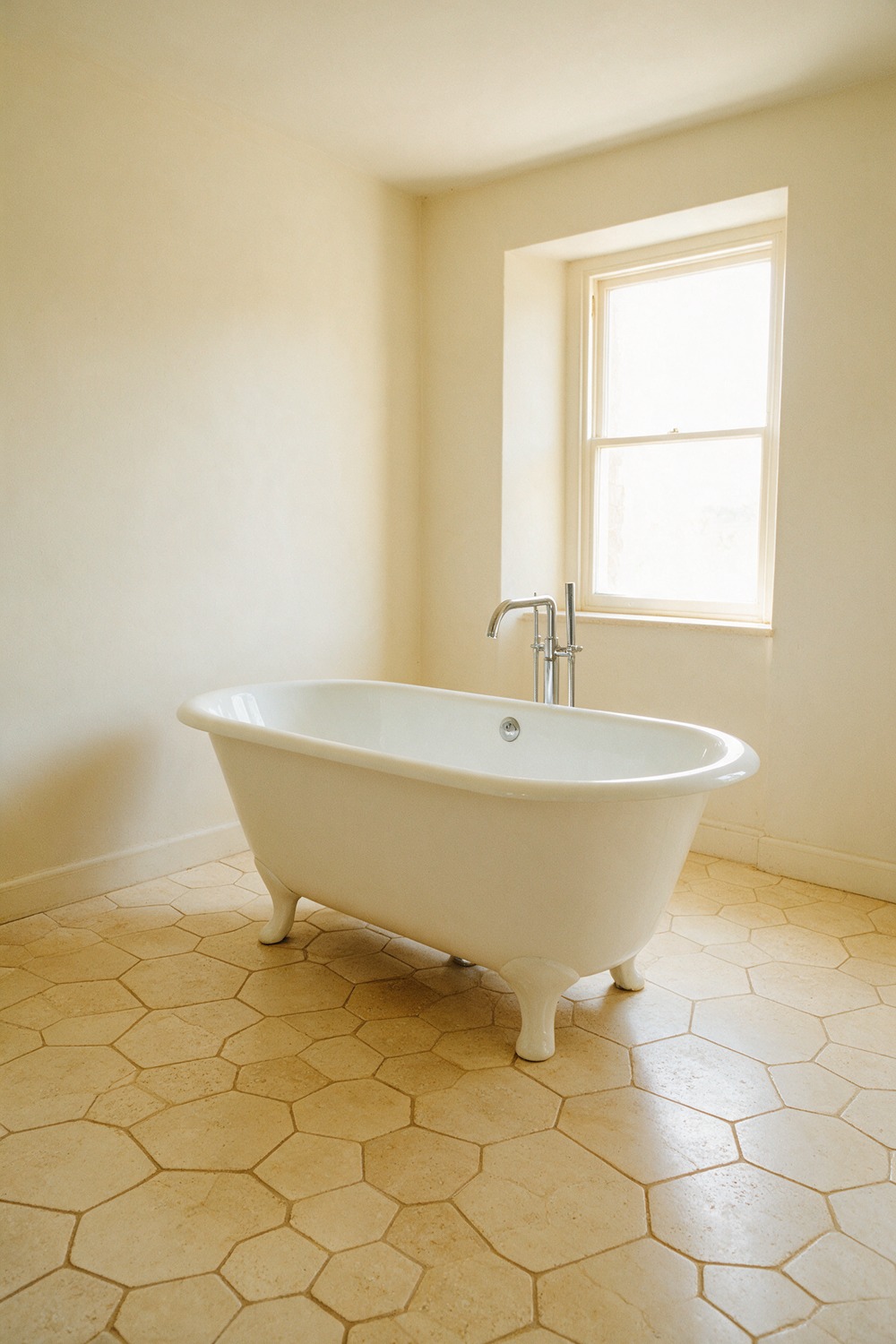
Hexagons give travertine a gentle geometry without any hard edges, which suits the stone’s soft nature. On a floor they feel fresh and a touch retro, honoring those old hex bathroom floors but in warm stone instead of cold white porcelain.
Pro tip: oversized hexes, the big ones rather than penny-tile size, read calmer and far more modern. Keep the walls creamy and let the floor pattern be the star, with a warm white like Dulux Natural Calico above.
Ask for 4-inch or larger honed travertine hexagons, and grout in a close sand tone. Start the floor from the sightline you see first through the door.
13. Subway Travertine Bathroom
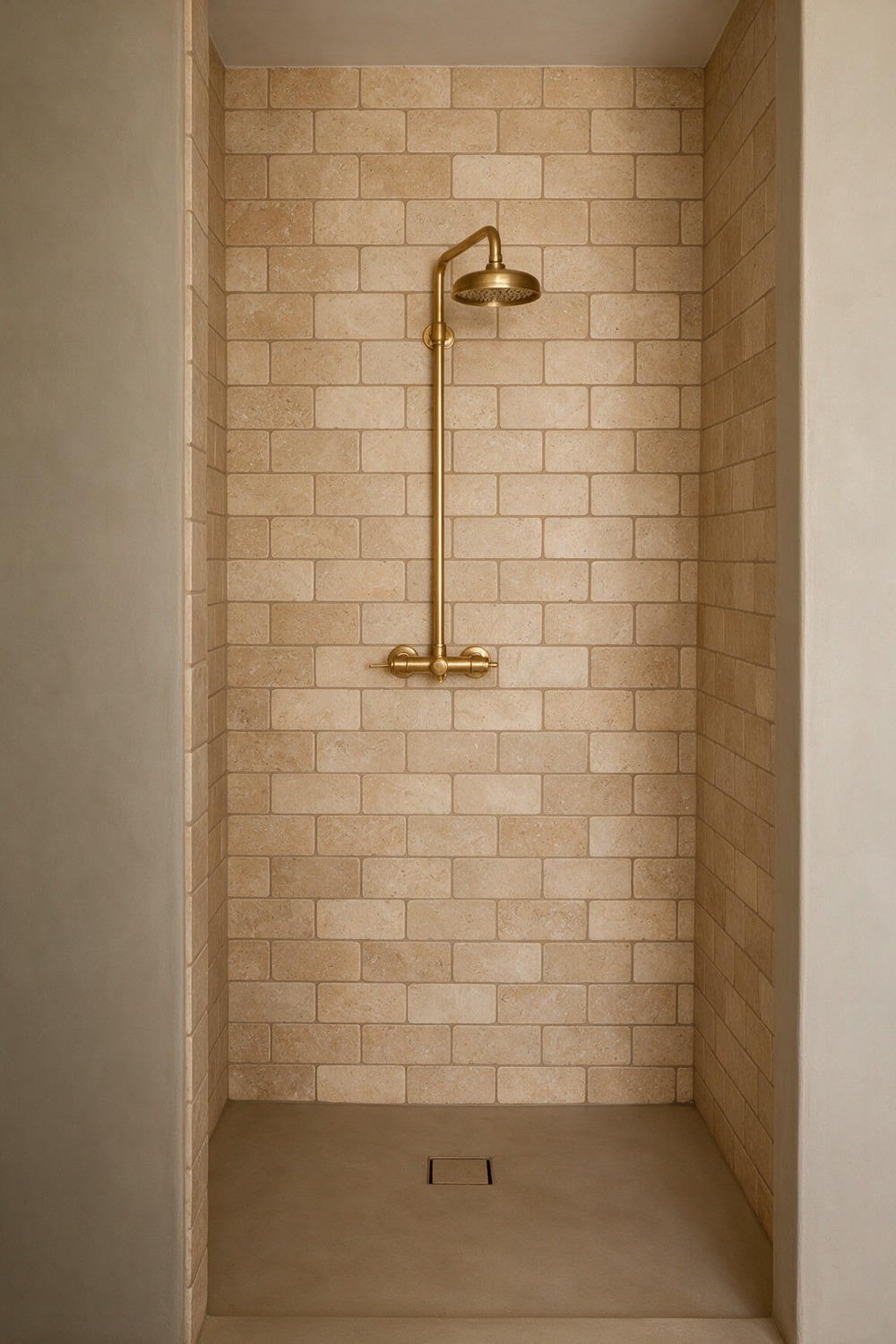
Subway is the brick-laid rectangle everyone knows, but in travertine it loses the clinical coolness of white ceramic and turns warm and soft. It is the failure-proof option, and there is no shame in that. Classic for a reason.
Go tonal: biscuit 3×6 honed travertine, a greige wall in Benjamin Moore Pashmina, and brushed-brass fittings. Run it in a standard half-offset brick bond with tight tone-matched grout, and let the main shower wall be your anchor.
14. Large Format Travertine Bathroom
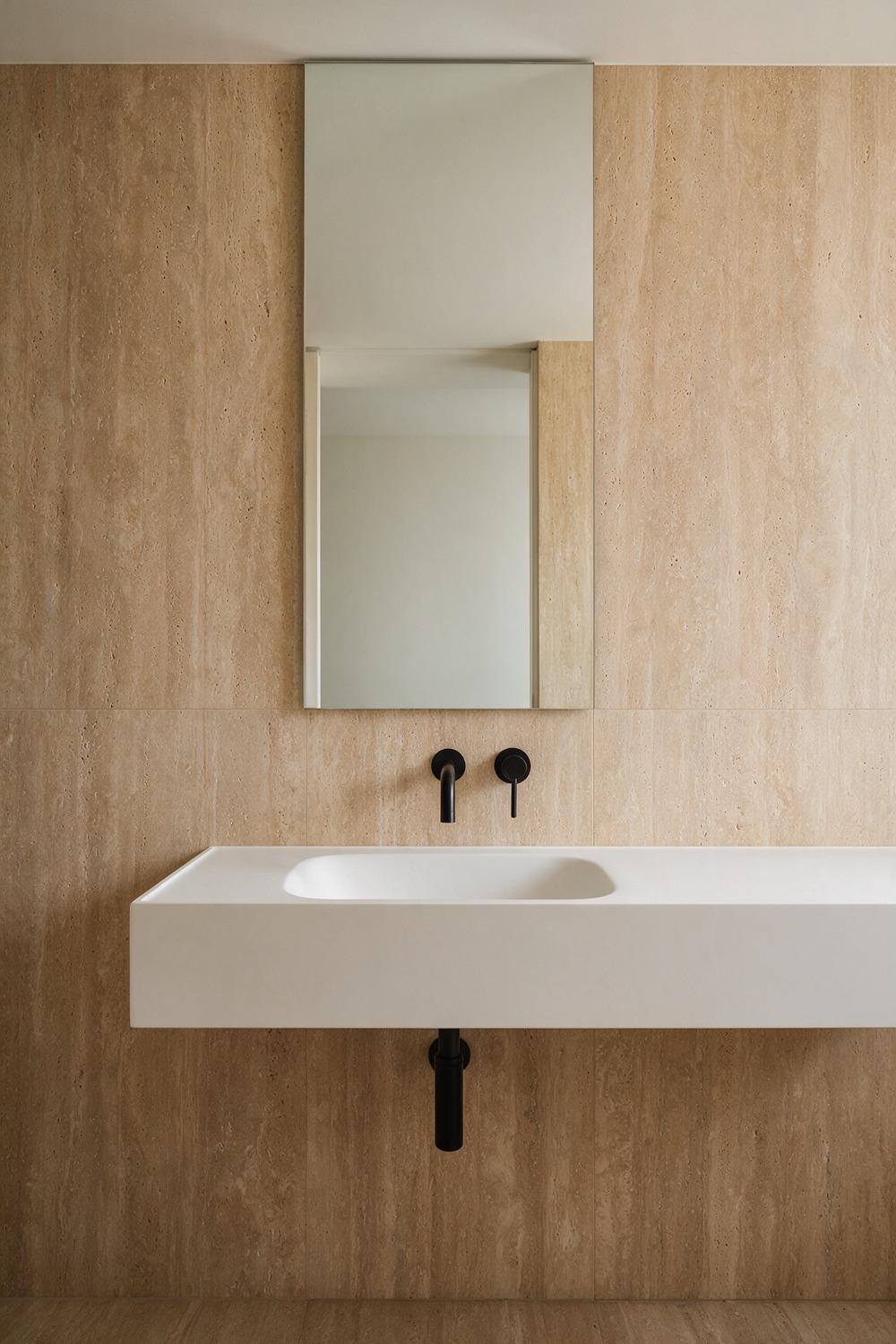
Large-format tiles and slabs mean fewer grout lines, and fewer grout lines mean a calmer, more contemporary, more seamless room. This is how you get the high-end hotel look. The big pieces are heavy to handle, so this one is worth handing to a pro.
Minimal joints make a small bathroom feel bigger, so do not be scared of big tile in a little room. Keep everything tonal and quiet: a sand floor-to-ceiling, walls in Sherwin-Williams Shoji White, and slim matte-black fixtures.
Spec 24×48 honed large-format travertine or full slabs, and tone-match the grout to near-invisible. The biggest uninterrupted wall is the one to tackle first.
15. Mosaic Travertine Bathroom
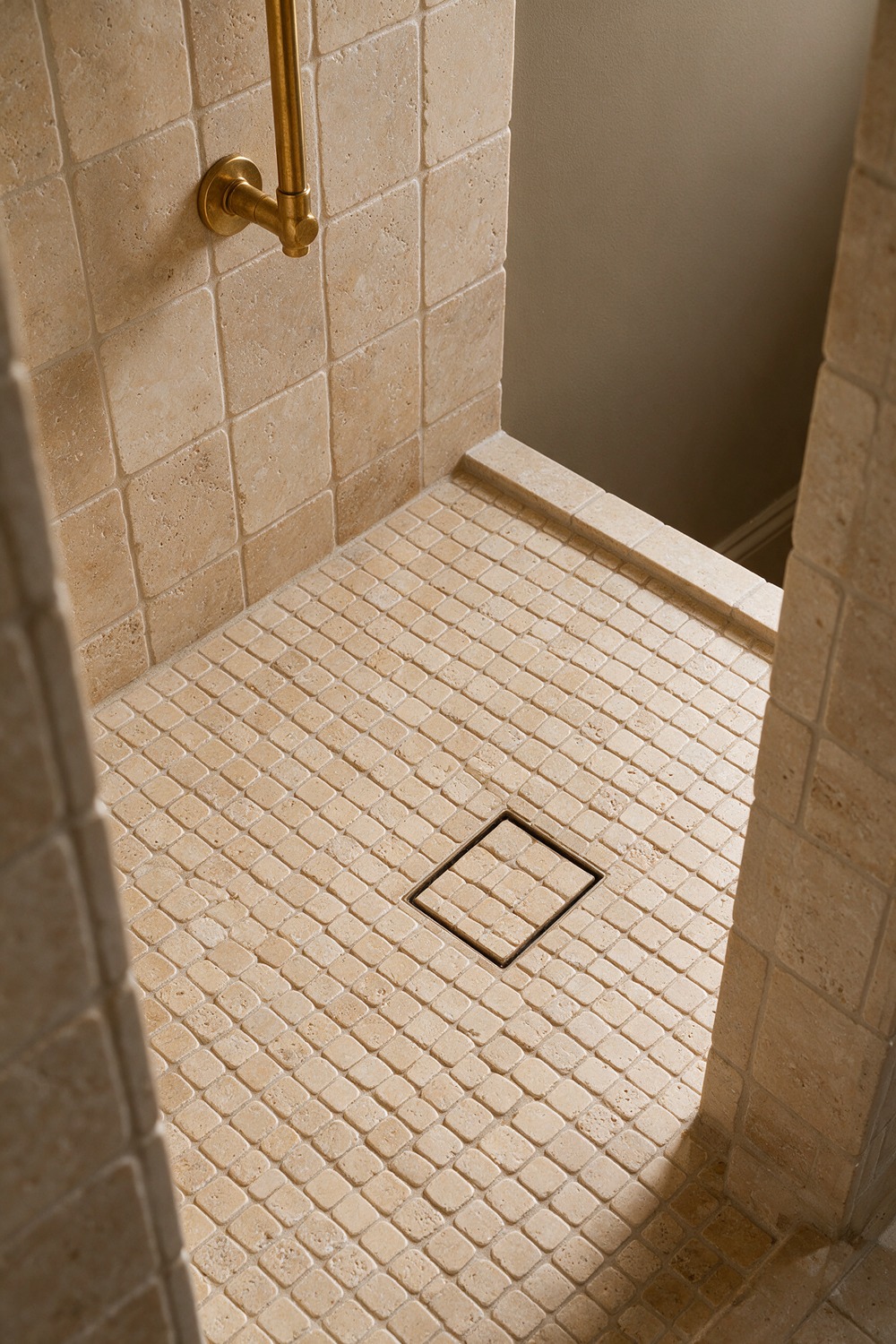
Mosaic breaks travertine into little chips set on a mesh, and all those tiny tumbled pieces catch light and shadow in a way big tile cannot. I love it as an accent, a shower floor, a niche, a border, where the extra grout actually adds grip and texture.
Use it where small scale makes sense rather than everywhere at once. A pebble or square travertine mosaic on the shower floor against larger wall tile is my go-to combination.
Pair with a warm greige wall like Little Greene’s French Grey, and order tumbled travertine mosaic sheets. The shower pan is where I would use it first, because the texture underfoot feels wonderful.
16. Plank Travertine Bathroom
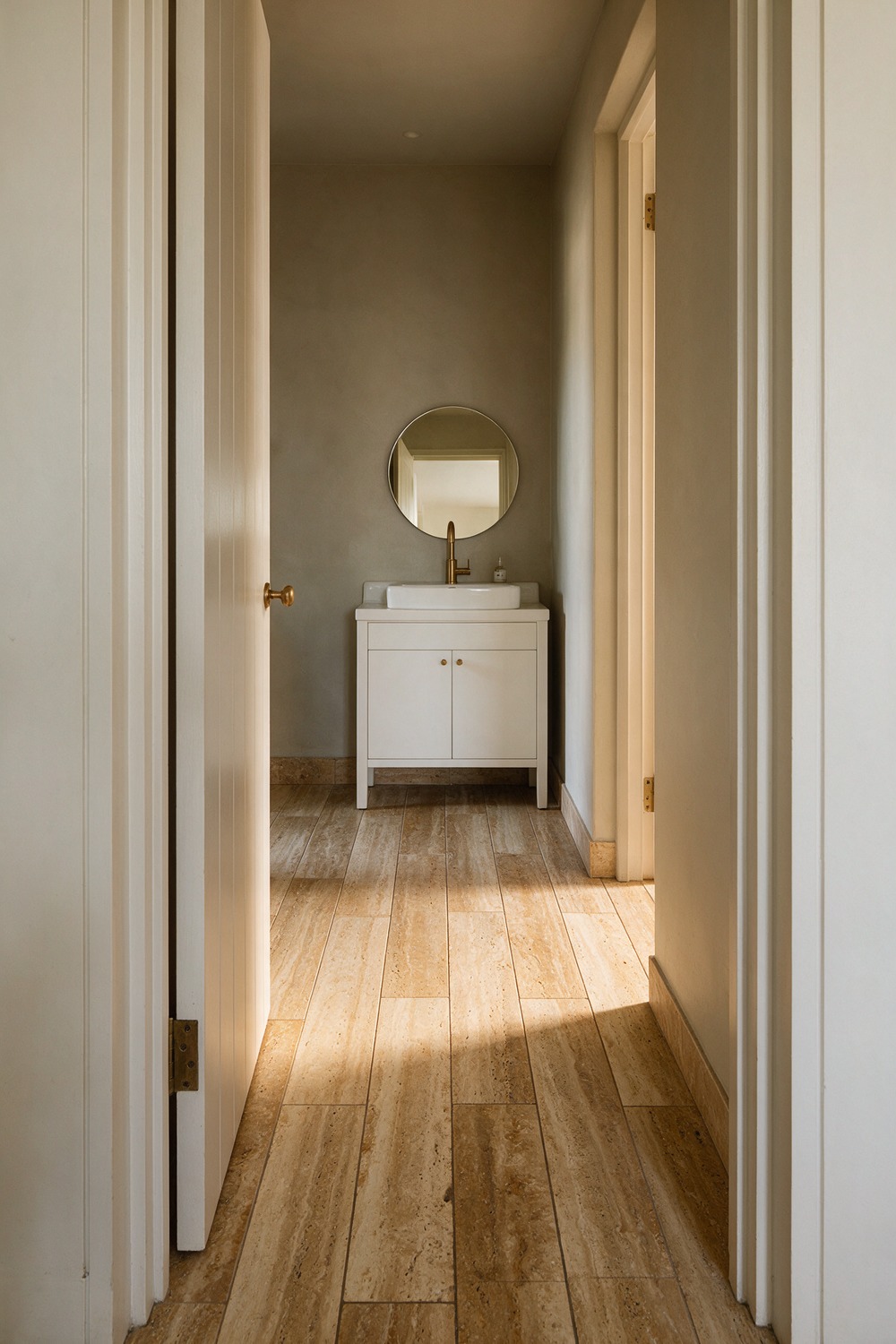
Plank travertine comes in long, narrow, wood-like proportions, giving you the warmth and rhythm of a timber floor with the durability of stone. It is a clever trick for anyone who wants a wood look somewhere wood should not go.
Run the planks lengthwise down a narrow room and it stretches the space. The warm tan and cream tones sit well under a soft greige like Backdrop’s Current Mood. Ask for 6×24 or 8×36 honed planks, lay them in a one-third offset like floorboards, and begin from the doorway.
17. Scabos Travertine Bathroom
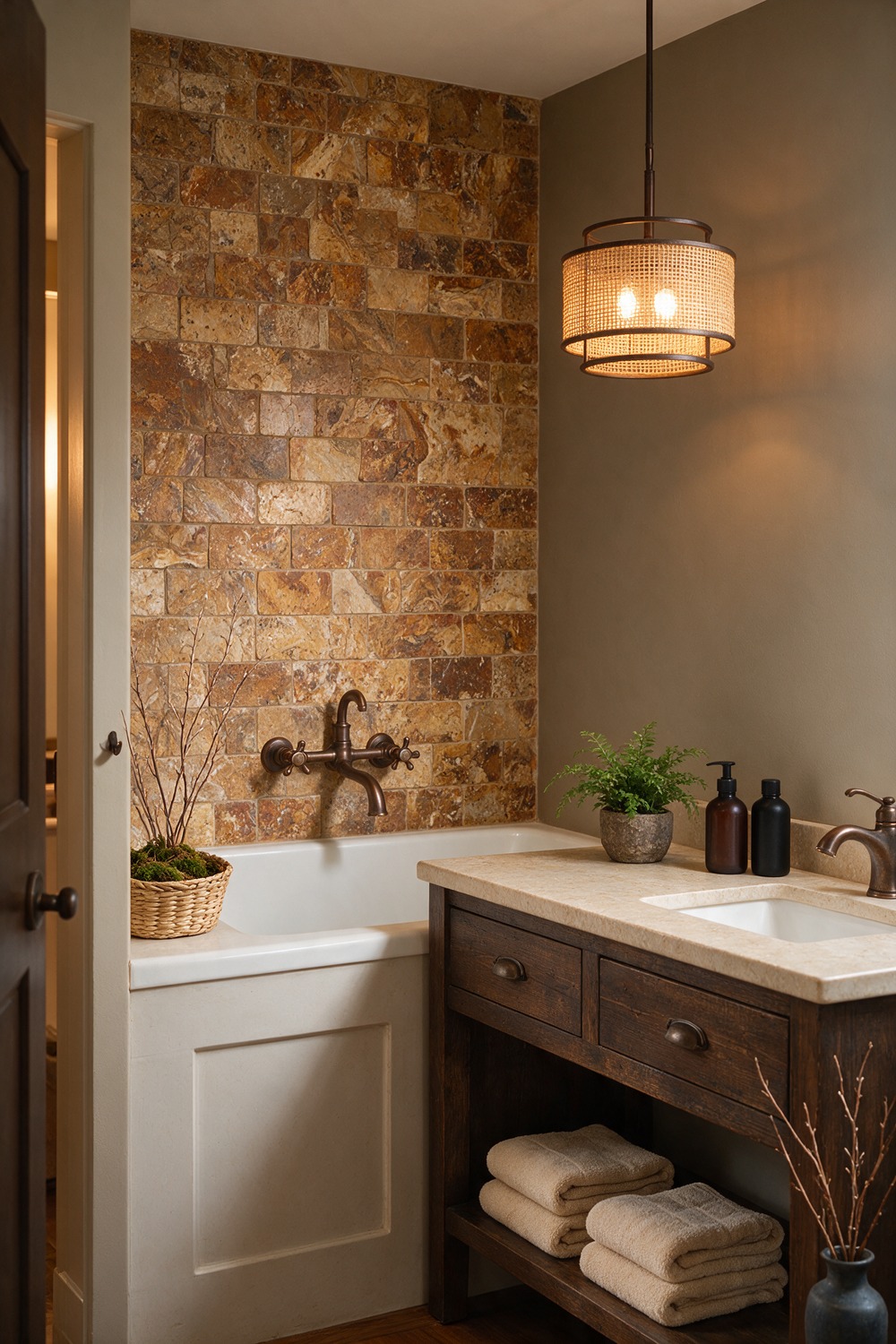
Scabos is the multi-tonal blend, a mix of travertine’s warm browns, tans, golds, and rusts in one tile, usually tumbled and full of movement. It is the richest, most rustic member of the family, and it brings an autumnal, earthy depth nothing else quite matches.
Because the stone carries so much color, keep absolutely everything else calm. A warm taupe wall like Farrow & Ball Oxford Stone lets the stone’s range sing without a fight.
This is the one travertine that fills a room with warmth on its own. In lamplight the rusts and golds glow like a fire just went down. One honest confession: it is not a minimalist’s stone, so if you crave calm uniformity, look back up at honed.
Order scabos, sometimes called noce blend, travertine in a 4×4 or French pattern, and grout in a mid-tan. Start with one bold wall before deciding whether you want more.
Which Travertine Bathroom Style Is Right for You
If you want calm and contemporary, you are in honed, large-format, or vein-cut territory, smooth stone and few grout lines. That is the hotel-quiet route.
If you want warmth, age, and character, go tumbled, chiseled-edge, unfilled, or scabos, where the texture and the shadows do the work. That is the old-villa route.
Love pattern? The French pattern, herringbone, hexagon, and mosaic give you something to look at on the floor without shouting. And if you are nervous, subway and filled-and-honed are the gentle, no-regrets entries.
I would tell most first-timers to start honed and tonal, then add one patterned moment, and resist the urge to do all seventeen things at once.
Travertine Bathroom Remodels, Answered
Is travertine expensive? It sits in the comfortable middle. Honed and tumbled field tile is affordable, often cheaper than premium porcelain; polished slabs and large-format pieces are where cost climbs. A small accent wall is a low-cost way to test the look first.
Can I lay travertine myself, or do I need a pro? Small 4×4 tumbled tile on a feature wall is a doable weekend DIY if you are handy. Large-format tiles, slabs, and intricate French or herringbone patterns really do want a professional tiler.
How long does a travertine bathroom take? A single accent wall is a day or two. A full retile, floor and walls, is realistically one to two weeks once you factor in demolition, setting, grouting, and sealing time. Stone is not a rush job, and the sealing step matters.
What do I ask the tiler for? Name the cut (vein or cross), the finish (honed, tumbled, polished), and whether it is filled or unfilled, because those three choices change everything. Ask them to dry-lay a patterned floor, tone-match the grout, and seal the stone before and after grouting.
Is travertine high-maintenance? It asks for a good penetrating sealer and pH-neutral cleaners, no harsh acidic sprays. Filled and honed is the lowest-fuss combination; unfilled and polished ask for a little more love. Seal it well and it will age gracefully for decades.
Start with one wall. Order a few samples, sit them in your actual bathroom light for a day, and watch how the stone warms up at dusk. That small step is how every beautiful travertine bathroom begins, and your calmest room is closer than you think.
More stories
Share this story