7 Breathtaking Sunrise Spots Across America That Are Worth Setting the Alarm For

I have a complicated relationship with mornings. I am not, by nature, someone who springs out of bed before the sun. Coffee has to happen first. Coherent sentences come later.
But I have dragged myself out of a warm sleeping bag in the dark more times than I can count — because something about the promise of a spectacular sunrise turns out to be a more effective alarm clock than anything on my phone.
There’s a particular reward waiting for people willing to set a very early alarm and go somewhere intentionally. Sunrise isn’t just a daily event. In most places, it’s an event that happens whether or not anyone bothers to show up for it.
In the right location, it’s something closer to a ceremony — the landscape transforming in real time, colors shifting faster than you expect, everything quiet in a way that feels borrowed from a different world.
America’s most spectacular sunrise spots range from ancient craters in Hawaii to Atlantic-facing mountaintops in Maine. Below are seven of the best, each one worth losing a little sleep over.
Pro tip for every one of these: the sunrise photographer’s adage applies. The light before the sun actually crests the horizon is often more dramatic than the moment of sunrise itself. Arrive earlier than you think you need to.
And dress in more layers than seem necessary. The temperature difference between 4 a.m. and 7 a.m. at most of these locations is larger than it looks on a weather app.
Finally: no matter how spectacular the sunrise turns out to be, the real payoff tends to arrive about an hour later, when the world has warmed up, and you realize you did something most people around you haven’t done in years.
1. Cadillac Mountain, Maine
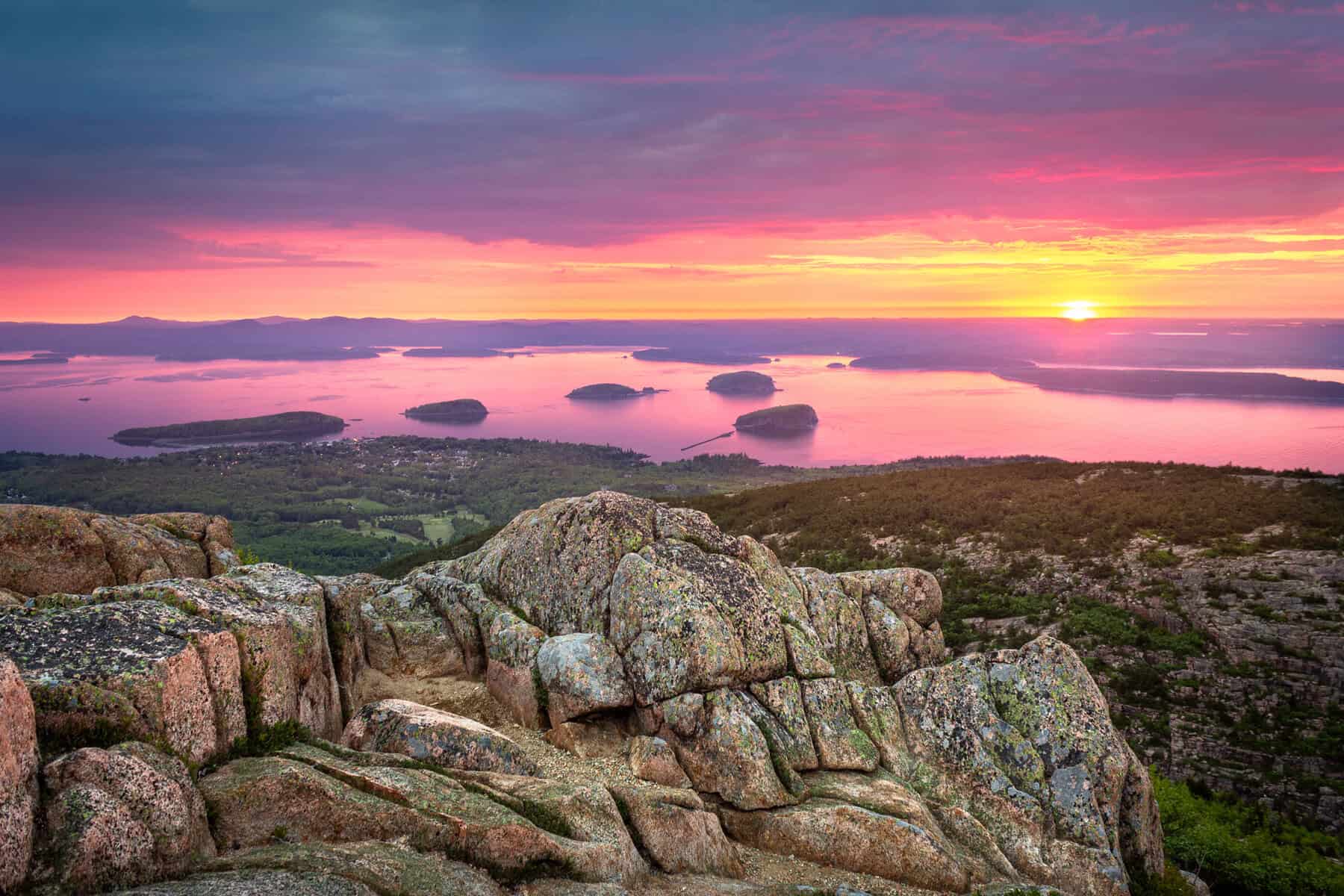
Cadillac Mountain in Acadia National Park is the first place in the continental United States to receive sunrise light at certain times of the year. That alone is reason enough to climb it in the dark. The view from the 1,530-foot summit makes the physical argument even more compelling.
The rocky, exposed summit looks out over Frenchman Bay, the forested Porcupine Islands, and the Atlantic Ocean stretching to the horizon. When the light begins, it does so in every direction at once — the water, the islands, and the sky all catching color simultaneously.
Maine’s fall and winter skies tend to produce the most dramatic color, and the national park’s reservation system requires planning the visit in advance during peak season.
The trail to the summit is manageable in darkness with a headlamp, and watching other hikers appear at the top as the sky lightens overhead creates an unexpected sense of shared anticipation.
The summit’s open granite top and the panorama of Frenchman Bay make Acadia one of those parks that rewards early arrivals in a way that mid-morning visitors never quite experience.
Where: Cadillac Mountain Summit, Acadia National Park, Bar Harbor, ME 04609
2. Haleakalā Volcano, Hawaii
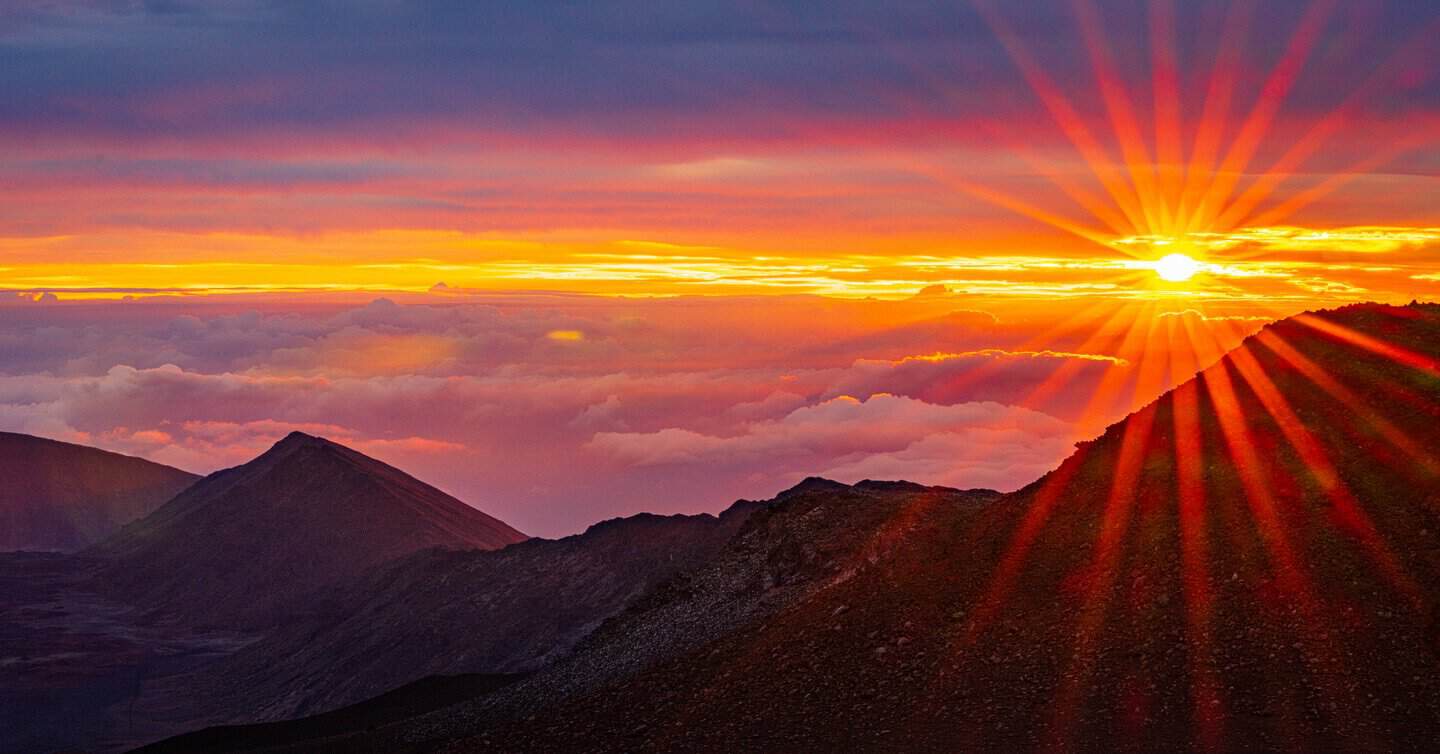
Watching sunrise from Haleakalā’s summit on Maui requires planning and patience. At 10,023 feet, the summit sits above a cloud layer that catches the first light of day, turning the world below into illuminated white.
The sun rises directly through that layer — unlike any other sunrise in the country.
The National Park Service requires advance reservations for summit sunrise access, and securing one early is essential — demand routinely outpaces availability by weeks.
The temperature at the summit can be dramatically colder than the beach hotels just two hours below, so layers are non-negotiable. Arriving in the dark and waiting in the cold is simply part of what makes the eventual light feel so earned.
In Hawaiian tradition, Haleakalā, whose name translates to “House of the Sun,” holds deep spiritual significance, giving the sunrise experience a cultural layer that makes the early alarm feel less like an inconvenience and more like a privilege.
The drive down from the summit after sunrise passes through several distinct climate zones, from alpine desert to cloud forest to tropical coast, making the morning feel even longer and more complete than the hour around sunrise alone.
Where: Haleakalā National Park, Haleakalā Crater Rd, Kula, HI 96790
3. Mesa Arch, Utah
Mesa Arch in Canyonlands National Park has been photographed so many times that it has become one of the most iconic images in American landscape photography.
That doesn’t make seeing it in person any less extraordinary — familiarity with the image only deepens the impact of the real thing.
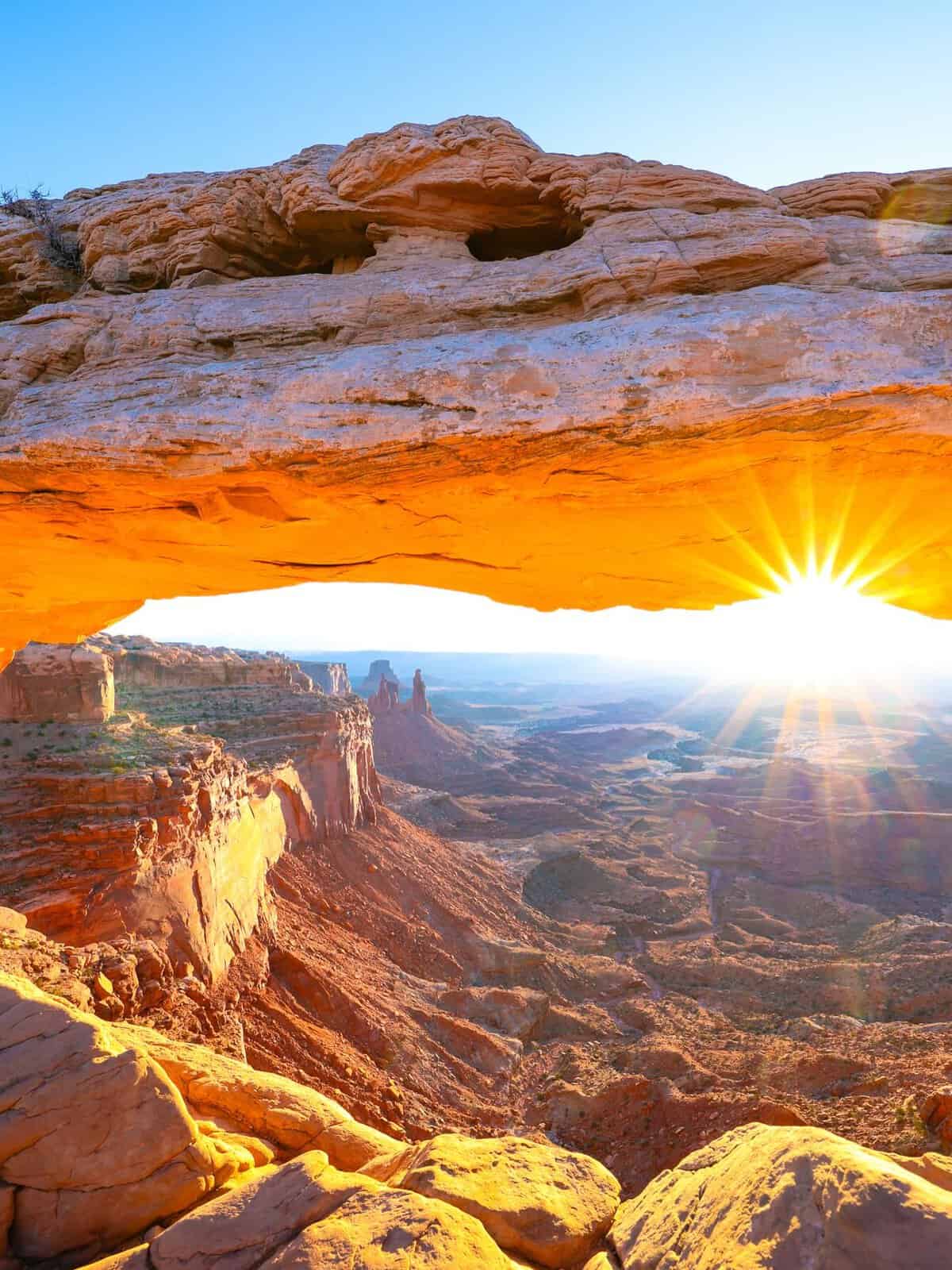
As the sun rises over southeastern Utah, its light passes beneath the natural sandstone arch and reflects upward from the canyon walls below. The arch appears to glow from the inside, lit amber and orange in a way that looks digitally altered until you’re standing directly in front of it.
The trailhead is a short, half-mile walk on mostly flat terrain, making this one of the more accessible spectacular sunrise experiences in the country.
Arrive very early — professional and amateur photographers often claim positions before 5 a.m. during peak season, and the arch is surrounded on three sides by a sheer canyon drop.
The surrounding canyon country of southeastern Utah offers several other sunrise destinations within an hour’s drive, making Moab an ideal base for a multi-day commitment to early mornings.
Where: Mesa Arch Trailhead, Canyonlands National Park, Moab, UT 84532
4. Cape Hatteras National Seashore, North Carolina
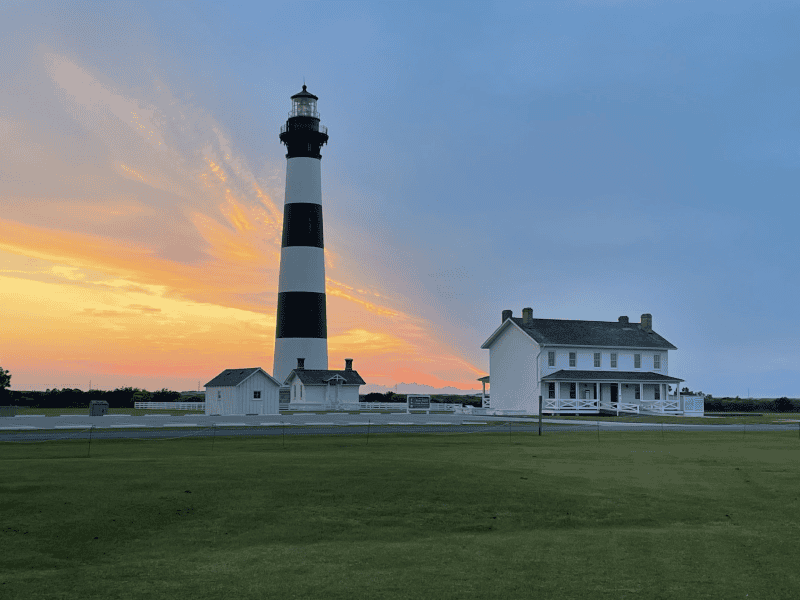
The Atlantic Coast delivers a particular kind of sunrise that those who grew up on the other side of the country often haven’t experienced: the sun rising directly out of the ocean, no intervening landmass, the horizon a clean line between dark water and a lightening sky.
Cape Hatteras National Seashore on North Carolina’s Outer Banks is one of the finest places in the country to experience exactly that. The narrow barrier island with water on both sides creates a sense of exposure to the sky that feels more like being at sea than being on land.
The lighthouse itself, striped in its distinctive black-and-white spiral, appears in silhouette as the eastern sky brightens — a composition that rewards photographers willing to position themselves early.
Migratory shorebirds gather here in significant numbers during spring and fall migration, which means the pre-dawn soundtrack of a Cape Hatteras sunrise often includes bird calls that most people have never heard in person.
The Outer Banks’ remoteness — accessible only by a single highway and a few ferry routes — means that arriving here at all carries a sense of effort that makes the sunrise feel appropriately earned.
Where: Cape Hatteras National Seashore, 1401 National Park Dr, Manteo, NC 27954
5. White Sands National Park, New Mexico
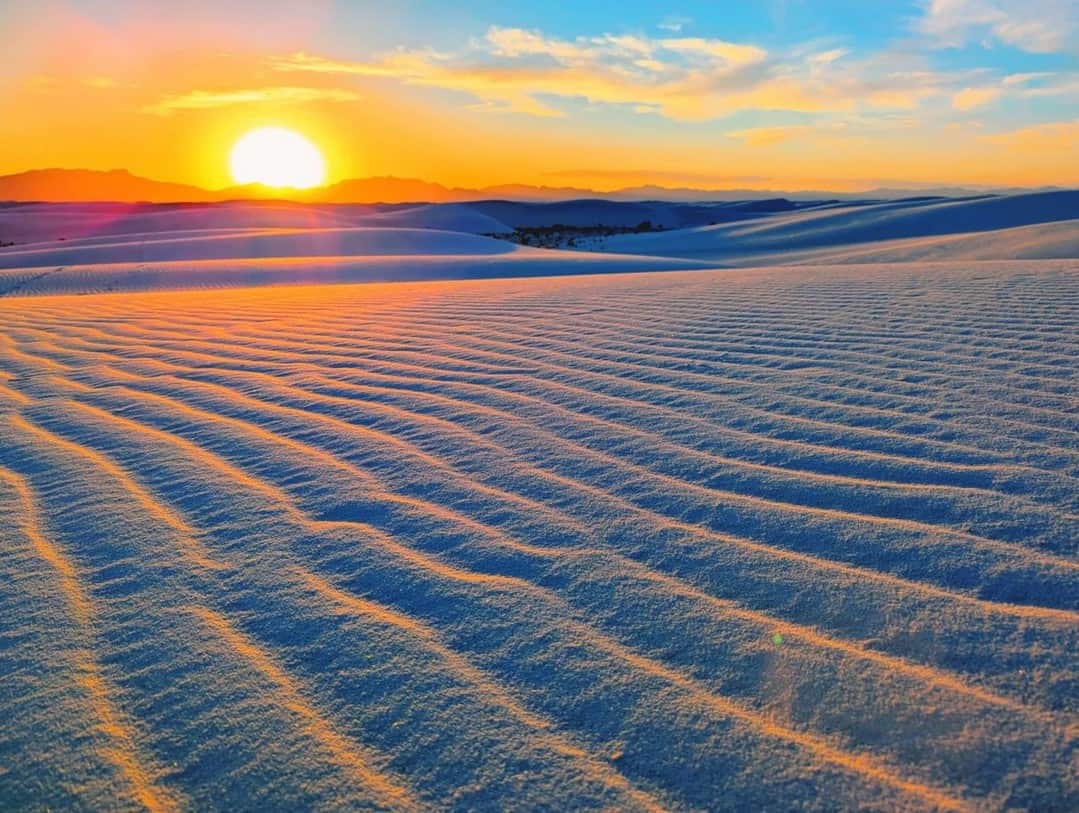
At most sunrise locations, the landscape is the backdrop for the light. At White Sands in New Mexico, the landscape is an active participant. The 275 square miles of white gypsum dunes reflect and amplify light, turning sunrise into something that glows from below as much as above.
The dunes range from pale ivory to warm peach to deep gold depending on the angle and quality of the light, and those shifts happen fast enough during the hour around sunrise that the scene changes every few minutes.
White Sands is located in the Tularosa Basin between two mountain ranges — the San Andres to the west and the Sacramento to the east — which means sunrise produces layered shadows that add depth to the already extraordinary landscape.
Exploring the backcountry campsites within the park allows overnight stays directly among the dunes, with sunrise arriving without the walk back to the car.
The park also closes periodically due to missile testing at the adjacent White Sands Missile Range — checking the schedule before the visit is a practical detail that no sunrise here should be disrupted by.
Where: White Sands National Park, 19955 US-70, Alamogordo, NM 88310
6. Maroon Bells, Colorado
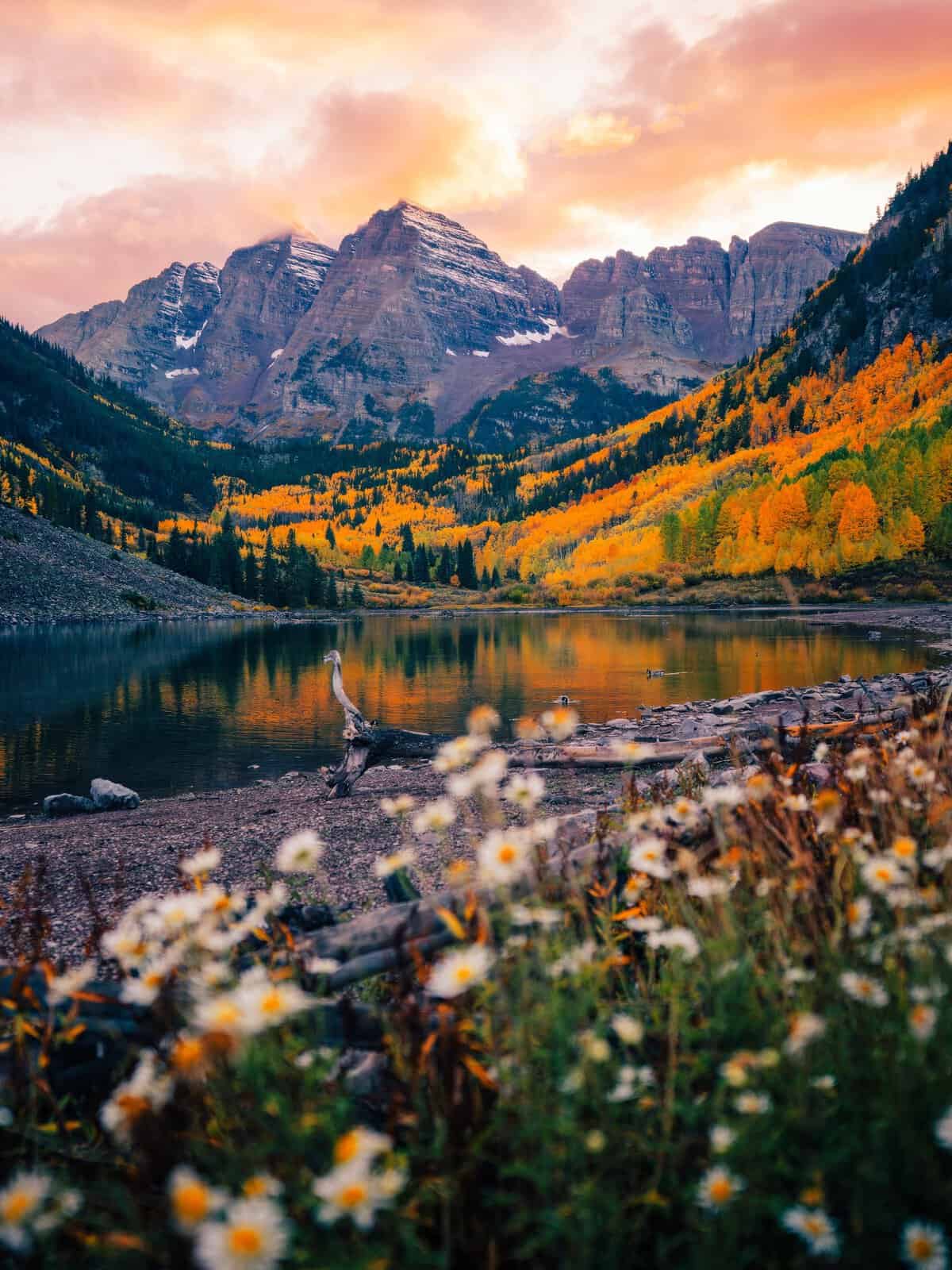
The Maroon Bells are the most photographed mountains in North America — a designation reflecting how difficult it is to take a bad photograph here.
Two nearly identical 14,000-foot peaks rise above Maroon Lake near Aspen, and in the early morning, the still lake surface acts as a mirror.
At sunrise, the reflected Bells appear in the still water below the actual peaks, doubling the drama.
The aspens ringing the lake turn golden in late September, creating a brief window when reflected peaks, golden trees, and morning light produce one of the most extraordinary natural compositions in the country.
A shuttle system from Aspen controls access to the area during peak season, and sunrise visitors typically need to arrive before the first shuttle to secure a position at the lake’s edge.
The surrounding Maroon-Snowmass Wilderness offers extensive hiking for those who want to extend the morning beyond the initial sunrise.
Late September’s aspen foliage window draws the largest crowds of the year, and securing a shuttle reservation well in advance during that peak period is essential for anyone planning to photograph the Bells at dawn.
Where: Maroon Bells Scenic Area, Maroon Creek Rd, Aspen, CO 81611
7. Crater Lake National Park, Oregon
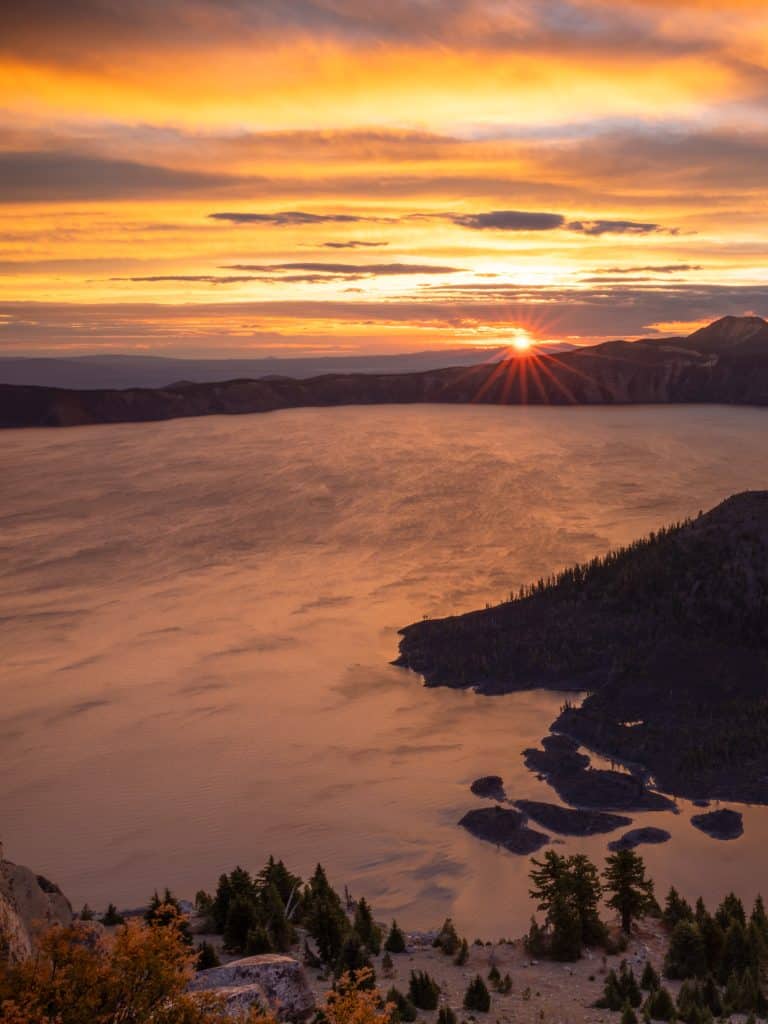
Crater Lake formed when Mount Mazama collapsed after an enormous eruption roughly 7,700 years ago, creating a caldera that filled with snowmelt and rain.
The resulting lake is the deepest in the United States at 1,943 feet, its water so intensely blue that photographs are often mistaken for digital enhancement.
At sunrise, the crater rim catches light before the lake below, creating a layered sequence of illumination — rim first, then the cinder cone island called Wizard Island, then finally the surface of the lake itself shifting from dark to that impossible blue.
The 33-mile Rim Drive encircles the crater and provides access to dozens of viewpoints, each offering a slightly different perspective on the same extraordinary basin. Watchman Overlook on the western rim provides one of the most dramatic sunrise angles.
Snowpack at Crater Lake’s elevation of nearly 7,000 feet typically keeps the rim road closed until mid-June, making summer and early fall the primary window for sunrise access.
The park’s distance from major Oregon cities means its skies are dark enough for stargazing before sunrise, turning an early arrival into a two-part celestial experience — stars first, then the slow transformation of that impossible blue lake.
Where: Crater Lake National Park, Rim Village Dr, Crater Lake, OR 97604
Some Things Are Worth the Dark
There is a small, reliable humiliation in setting an alarm for 4 a.m. and immediately questioning every decision that led to that moment. The sleeping bag is warm. The tent is dark. Outside, it is cold, and the world is still.
Then you go anyway, because you came this far, and because something in you already knows that the light on the other side of the darkness will be worth the dark.
That is the real argument for sunrise travel — not the photographs, though the photographs are remarkable.
It’s the particular quality of attention that comes from being somewhere intentionally, in the uncomfortable dark, waiting for something that doesn’t perform on demand and doesn’t offer a second chance that day.
Sunrise also has a way of rearranging the rest of whatever follows it. A day that begins with something genuinely beautiful tends to feel different from a day that begins with checking your phone. That might be the real reason people keep setting those early alarms.
Set the alarm. Pack the layers. Find one of these seven places and be there before the light. You will not regret the early hour. Almost no one ever has. You may, in fact, begin setting that alarm more often than you expected.
And the next morning, when you’re back home, and it’s still dark outside and warm inside, you might just surprise yourself by going out again anyway.
That’s how the habit forms — not from discipline, but from remembering what the light looked like and wanting to see it again.
More stories


Share this story